Wheelie Life
- 4.3
- Rating
- 1.00M
- Installs
- Free
- Price

 Analysis by App-foxy
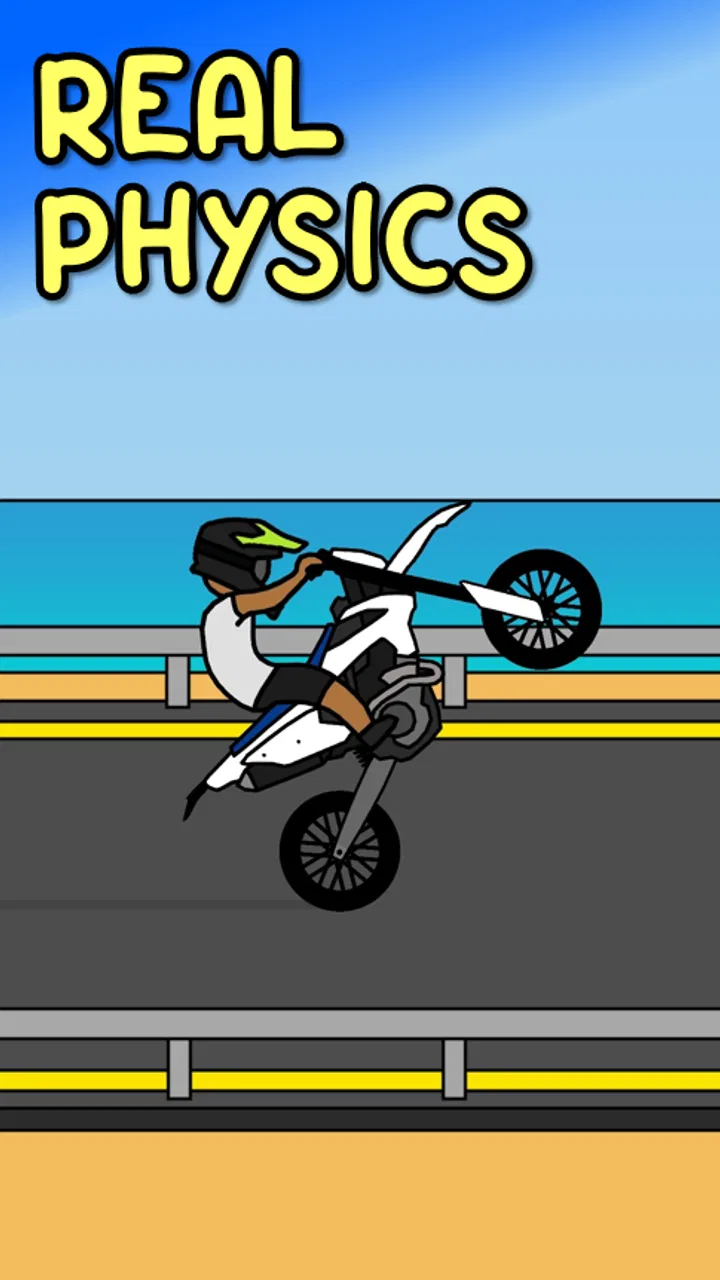
I approached Wheelie Life expecting a small, easy-to-understand racing game, and that is exactly where its appeal begins. Developed by ak.dev, it focuses on one clear idea: keeping a motorcycle balanced on its rear wheel for as long as possible. There is no need to learn a large set of racing rules before playing. You start, find the balance point, and try to turn a brief wheelie into a controlled ride.
That simplicity makes it a good fit for short sessions. I can imagine opening it while waiting for transport, playing a few attempts, and closing it without feeling that I have abandoned a complicated campaign. At the same time, the narrow focus means the game will not satisfy someone looking for a full racing package with deep vehicle tuning, large events, or a long story. Its success depends almost entirely on whether you enjoy repeating a physical challenge and improving through practice.
How the first attempts establish a clear goal
The early objective is immediately understandable: lift the front wheel, maintain control, and avoid losing the bike. That directness is one of the strongest parts of the experience. Instead of asking me to memorize tracks, manage several buttons, or study a long tutorial, the game puts the central skill in front of me almost at once.
You May Also Like

 Blood Strike: 2.5 Anniversary
Blood Strike’s Loadouts Turn Every Drop Into a Tactical Gamble
A close look at Blood Strike’s custom loadouts: how fast access to signature weapons reshapes its battle royale rhythm, rewards preparation, and narrows the gap between fights.

 Pandora - Music & Podcasts
Pandora’s Music Is Easy to Start, but Harder to Recover
Pandora’s strength is its low-effort path from a seed to a station. Its weak spot is how much confidence it asks you to place in connection, setup, and quiet recovery.

 8 Ball Pool
 Is Built on Rivalries, Rematches, and Routine
A close look at the rivalries, rematches, shared routines, and unanswered safety questions that turn a quick pool match into a persistent mobile community.

 Samsung Music
’s Quiet Strength Is Playing What You Already Own
Its reach comes less from spectacle than from dependable access to a personal library. That simplicity is both the app’s strongest retention engine and its ceiling.

 AccuWeather: Weather Radar
AccuWeather Review: A Quick, Clear Forecast for Everyday Decisions
For everyday plans, the best forecast is the one you can understand quickly. AccuWeather makes rain timing, radar, and local conditions easy to act on, with a few trade-offs.

 Hill Climb Racing
Why Hill Climb Racing Still Turns Crashes Into One More Run
A tiny car, a bumpy hill and one more upgrade: Hill Climb Racing keeps resurfacing because its simple chaos makes every near-miss feel personal.
More From Our News Desk
View All News


At first, the bike feels more delicate than the basic concept suggests. A small correction can decide whether the wheelie continues or ends. I found that the most useful early habit was to stop treating every attempt as a race against speed. The real challenge is reading the bike’s movement and making restrained corrections rather than constantly forcing it upward.
This creates a useful first goal beyond simply “go farther.” I began trying to make each attempt calmer and more repeatable. A lucky long wheelie is satisfying, but learning how to reach a stable position is more valuable. That distinction gives the opening sessions a modest training structure even though the game remains intentionally simple.
The 2D presentation also helps the first minutes feel readable. The action is shown from a side view, so the relationship between the bike, the ground, and the changing angle is easy to understand. I never felt that I was wrestling with a complicated camera while trying to learn the balance. For a game built around timing and control, that clarity matters more than visual spectacle.
Players who like immediate goals will probably appreciate this design. There is no long preparation phase before the interesting part begins. On the other hand, people who need a broad selection of objectives from the opening screen may find the experience thin. The early game is not about collecting a large set of activities; it is about refining one movement until it feels less accidental.
What progress feels like when the goal is skill
One interesting quality is that progress is felt through the player’s hands rather than through a dramatic stream of rewards. I noticed improvement when I could recover from a wobble that would previously have ended the attempt. I also became more aware of when I was overcorrecting. Those are small changes, but they make repeated runs meaningful.
This is an important distinction for anyone wondering whether the game has enough progression. If you need constant unlocks, new modes, or a visible campaign ladder, this may not be the right racing game for you. The central progression is practice-based. The game gives you a compact skill to understand, and the satisfaction comes from performing it more consistently.
I recommend setting personal targets instead of relying only on the game to provide motivation. For example, I would first aim to keep the front wheel raised through a controlled section, then focus on making three attempts with similar results. This approach turns random retries into a simple routine. It also exposes whether the core mechanic is enjoyable for you before you spend much time with it.
Another useful approach is to separate learning from chasing a personal best. During learning attempts, I pay attention to the moment the bike starts drifting out of balance. During record attempts, I avoid experimenting and use the correction that already feels dependable. Mixing those two mindsets can make the game feel more frustrating than it needs to be.
The lack of a broad progression structure can be both a strength and a weakness. It keeps the game focused and prevents unnecessary busywork, but it also means there is less to return to if the balance challenge itself stops being interesting. In my experience, the game works best for players who enjoy seeing their own control improve rather than waiting for the next major reward.
Where the difficulty curve becomes demanding
The difficulty does not come from a complicated opponent or a crowded track. It comes from maintaining precision for longer than feels comfortable. Early success can be misleading because a short wheelie may seem easy, while extending it requires more patience and better timing. That gradual increase in pressure is what gives the simple control system some depth.
I found that rushing creates most of my failures. When I tried to force a longer run immediately, I usually made larger corrections and lost the balance I had already built. A slower rhythm worked better: establish the wheelie, watch the angle, and adjust only when necessary. This is a practical tip that makes the game feel less random without changing its basic controls.
The challenge is also affected by attention. A short session can feel relaxing when I treat it as a few focused attempts, but repeated failures become irritating if I play while distracted. The game asks for enough concentration that casual multitasking is not always compatible with good results. It is still accessible, but accessibility should not be confused with automatic success.
For younger players, the Everyone age rating makes the game broadly approachable, and the basic idea is easy to explain. However, a child who expects immediate mastery may need encouragement to view failed attempts as practice. The game’s appeal is stronger for someone who enjoys repetition and small improvements than for someone who wants a quick win every time.
Compared with conventional mobile racing games, this is a much narrower test of control. Typical racers offer overtaking, track selection, vehicle upgrades, and the excitement of finishing ahead of opponents. Wheelie Life replaces those layers with a single balancing problem. That makes it less varied than a full racing title, but it can also feel more approachable when I only want to concentrate on one mechanical challenge.
How the pacing supports short and repeated sessions
The pacing is built around attempts rather than long races. That structure suits a phone particularly well because I can play for a minute or continue for longer without needing to remember a complicated event. If I fail, the setback is limited to that run. I do not lose a large amount of campaign progress or have to replay an extended course before trying again.
That low commitment is one of the game’s practical strengths. In an everyday situation, such as waiting for an appointment, I can use it as a focused distraction. I do not need sound, a long uninterrupted block of time, or a plan for managing several menus. I can simply make a few attempts, notice whether my balance is improving, and stop.
The same structure can create retention pressure of its own. Because an attempt ends quickly, it is easy to tell myself that I will try just once more. That loop is enjoyable when I am chasing a better result, but it can become repetitive if I am no longer learning anything. I think the best way to avoid that feeling is to stop after a clear practice goal has been reached rather than continuing automatically.
There is also a trade-off between simplicity and variety. A short session feels clean because the game does not bury the main action under preparation. Yet after several sessions, I may want a stronger reason to return than the next personal improvement. Players who prefer changing environments or a steady stream of new challenges should keep their expectations measured.
The game is free to play, which makes trying it straightforward. Optional in-app purchases range from $2.99 to $8.49 per item. I would treat those purchases as a personal choice rather than part of the basic reason to install the game. The core question is whether balancing the bike is enjoyable on its own; if it is not, spending more will not solve that fundamental mismatch.
Who will enjoy the focused design, and who should skip it
I would recommend this racing game to someone who likes physics-based timing, compact arcade ideas, and repetition with a clear purpose. It is especially suitable for players who enjoy turning an awkward movement into a reliable technique. The side-view format makes the action easy to follow, while the short attempts make experimentation inexpensive.
I would be more cautious recommending it to someone searching for a traditional racing career. If your ideal game includes several bikes, detailed customization, rival drivers, structured championships, or a large collection of tracks, this is unlikely to replace those experiences. Its identity is much closer to a focused wheelie simulator than to a complete motorsport game.
It may also be a poor match for players who dislike restarting. Even though each attempt is brief, the central loop naturally involves failure and repetition. The game does not hide that. Its satisfaction comes from gradually reducing mistakes, so anyone who finds repeated practice dull may run out of reasons to continue fairly quickly.
On the other hand, players with older Android devices may find the compatibility appealing: the game supports Android 7.0 and above. I would still judge it primarily by its control style rather than by its technical requirements. A broad device range makes access easier, but it does not change the fact that the experience is deliberately small and skill-focused.
What the audience response suggests about its place
The game has passed one million installs and holds an average rating of 4.4 from around 3.3 thousand ratings. Those figures suggest that the focused concept connects with a sizeable group of players, while the rating indicates generally positive reception. I read that as evidence of a clear audience rather than proof that it will suit everyone.
The developer, ak.dev, has kept the identity straightforward: a compact racing game centered on wheelie control. That focus is valuable because it avoids pretending to be a large simulation. When I judge it on its own terms, the design feels coherent. When I compare it with feature-heavy racers, the missing breadth becomes obvious, but that is also what keeps the learning curve approachable.
The current version is 4.7, and the game was released on February 10, 2022. For a player deciding whether to try it now, the more important consideration is still the loop itself. A version number does not tell me whether I will enjoy repeating the same skill, so I would use the free entry point to test that immediately.
My practical way of playing it
When I want a more satisfying session, I begin with a few low-pressure attempts instead of trying to beat my best result immediately. I concentrate on the first moment of balance and notice whether my corrections are too sharp. Once the movement starts feeling predictable, I switch to longer attempts. This prevents the common mistake of chasing distance before understanding control.
I also find it useful to treat failures as specific problems. If the bike rises too aggressively, I need a gentler start. If it drifts after a stable section, I am probably correcting too late or too much. Thinking this way gives each restart a purpose. It is a small but important difference between practicing and simply tapping through unsuccessful runs.
For a quick everyday session, I would set one narrow target: a smoother opening, a longer stable section, or fewer emergency corrections. That target is realistic enough for a short break and gives me a reason to stop when it is achieved. Without a target, the repeated attempts can blur together and make the game feel more demanding than entertaining.
I would also avoid judging the game after only one awkward run. The first impression can be harsher than the later experience because the controls reward restraint, not frantic input. Give it enough time to see whether the balance starts becoming intuitive. If that learning process feels satisfying, the game has a good chance of becoming a dependable short-session choice.
My verdict on the progression and long-term appeal
Wheelie Life succeeds because it understands its own scale. It does not need a complicated campaign to make a wheelie worth attempting, and its short-run structure makes practice easy to fit into ordinary phone use. The strongest progression is personal: I become steadier, recognize mistakes earlier, and turn a fragile trick into something I can repeat.
That design also sets a firm limit. The game’s long-term appeal depends on how much pleasure I get from refining one central skill. Players who want a stream of unlocks, changing race formats, or a strong competitive structure should choose a broader racing alternative. Those who enjoy focused arcade mechanics may find the lack of clutter refreshing.
My final recommendation is to try it with modest expectations. Think of it as a precise 2D balance challenge with racing flavor, not as a replacement for a full motorcycle racer. It is free, rated for Everyone, and easy to understand, but its real value appears only when I accept the repetition and use each attempt to learn something. For the right player, that narrow loop is not a weakness; it is the reason the game remains pleasantly easy to pick up and difficult to master.
FAQs for Wheelie Life
01What is Wheelie Life and what does it offer?
Wheelie Life is a captivating mobile game for Android and iOS where players can experience the thrill of performing wheelies on a motorcycle. With realistic physics and various environments, the game challenges you to master balance and control. It offers multiple levels, customizable bikes, and competitive leaderboards to enhance your gaming experience.
02Is Wheelie Life free to play, or does it require in-app purchases?
Wheelie Life is free to download and play, offering a basic set of features and levels at no cost. However, it includes optional in-app purchases for additional content such as special bikes, customization options, or to remove ads. These purchases can enhance your gameplay but are not necessary to enjoy the game fully.
03What are the device requirements for Wheelie Life?
To run Wheelie Life smoothly, your device should meet certain specifications. For Android, it typically requires version 5.0 or higher, and for iOS, version 10.0 or later. Ensure your device has sufficient storage and processing power to handle the game’s graphics and physics engine for an optimal experience.
04Does Wheelie Life offer multiplayer modes or is it a single-player game?
Wheelie Life primarily focuses on single-player gameplay, allowing you to practice and perfect your wheelie skills at your own pace. However, it also features a competitive leaderboard where you can compare your scores with other players globally, adding a social element to the game without real-time multiplayer interaction.
05How does Wheelie Life ensure a realistic gaming experience?
Wheelie Life uses advanced physics to replicate the real-life dynamics of performing wheelies on a motorcycle. The game’s developers have focused on creating realistic controls and movements, offering players an immersive experience. Different environments and weather conditions further enhance the authenticity, challenging players to adapt their riding style accordingly.
Pros
- Intuitive controls for easy gameplay.
- Engaging graphics keep the player hooked.
- Multiple levels for extended fun.
- Regular updates with new features.
- Competitive leaderboards enhance replay value.
Cons
- In-app purchases can be pricey.
- Occasional ads disrupt gameplay.
- May require internet for some features.
- Limited customization options.
- Battery drain on prolonged use.

Wheelie Life
Gallery